 Paper
 Demo
Real target bag Real
Real image A16 original · 0 inserted
ACM Multimedia 2026
* Corresponding author
 News
 Our paper has been accepted to ACM Multimedia 2026!
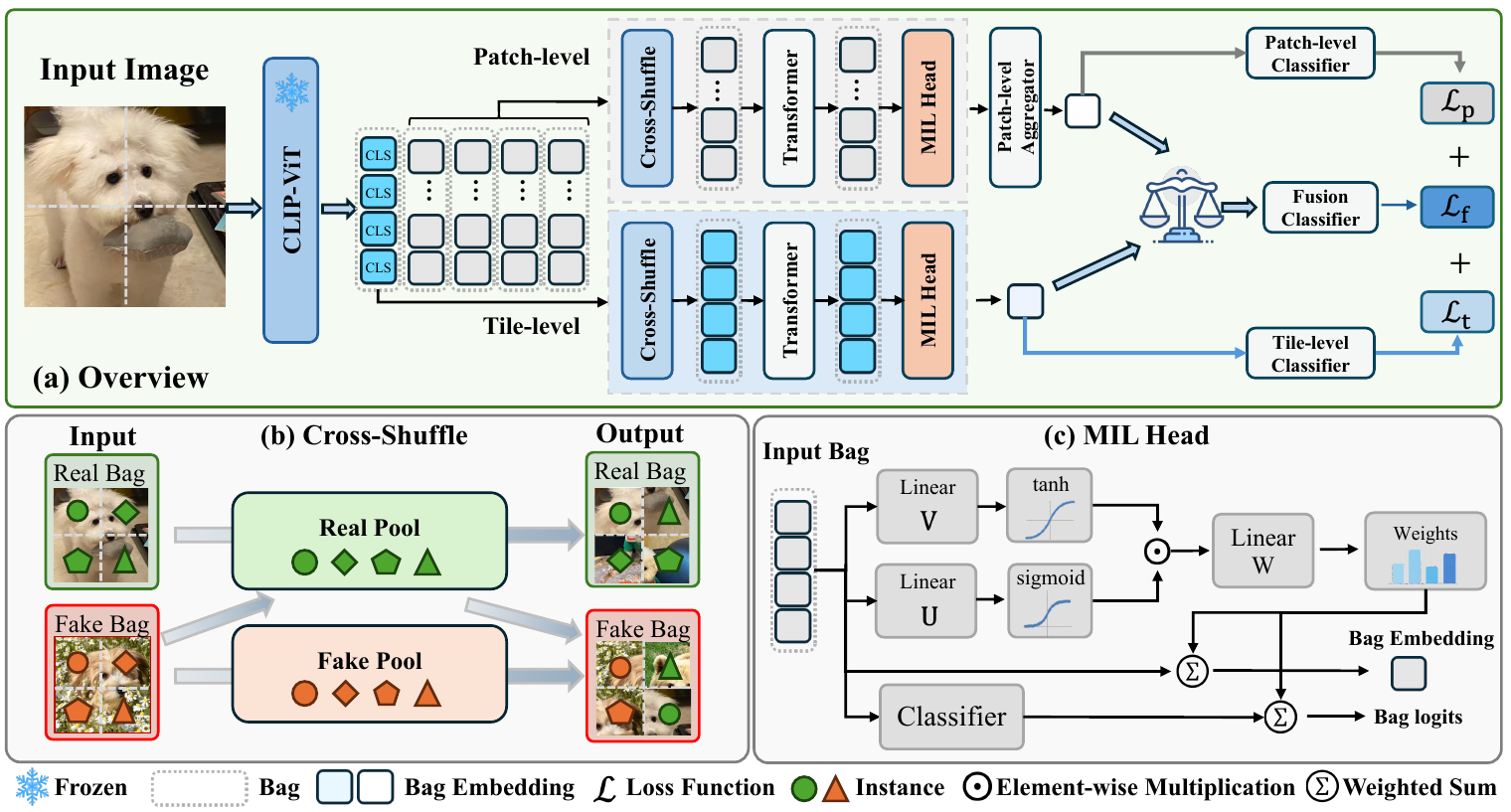
Recent advances in generative models have made synthetic images increasingly photorealistic, posing growing challenges to reliable and generalizable detection of AI-generated images. Existing methods typically rely on holistic image-level classification, which may overlook local artifacts, especially in high-resolution images. To address this limitation, we formulate this task as a falsification-driven multiple instance learning problem, where a single fake patch can falsify the whole image, while a real image requires all patches to be authentic. Based on this formulation, we propose Learning to Falsify (LTF), a hierarchical multiple instance learning framework that models an image as multiple bags of instances across different spatial levels and aggregates their predictions under the falsification-inspired principle. We further introduce Cross-Shuffle during training to encourage the model to learn local artifact evidence rather than image-level shortcuts. Furthermore, we propose the Falsification-driven Test-time Aggregation Strategy (FATAS), a plug-and-play module that extends the same falsification-inspired principle to existing detectors by aggregating patch-level predictions. Extensive experiments demonstrate that LTF achieves strong generalization and robustness across multiple benchmarks, while FATAS substantially improves representative detectors in high-resolution scenarios without retraining.
LTF formulates image detection as a multiple instance learning problem: local evidence of synthesis can falsify an image, while an authentic image requires its instances to be authentic.
The released GenImage profile uses CLIP block 24. See the checkpoint and reproduction notes for implementation details.
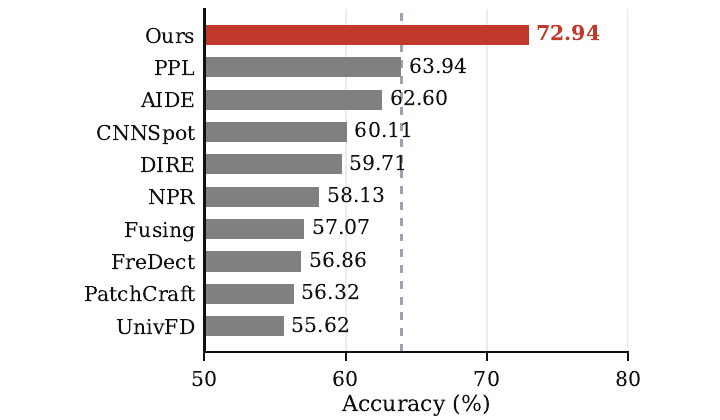
Selected results reported in the paper. Accuracy is shown in percent.
| Benchmark | Metric | LTF | Reference |
|---|---|---|---|
| GenImage | Mean accuracy | 98.4 | Table 1 |
| DRCT | Mean accuracy | 98.62 | Table 2 |
| Chameleon | Accuracy | 72.94 | Figure 3 |
| HiRes-50K | Average over 8 bins | 81.43 | Table 3 |
These are paper-reported results. The available weights and online demo use the GenImage checkpoint; they do not establish reproduction of every benchmark setting. Release notes.
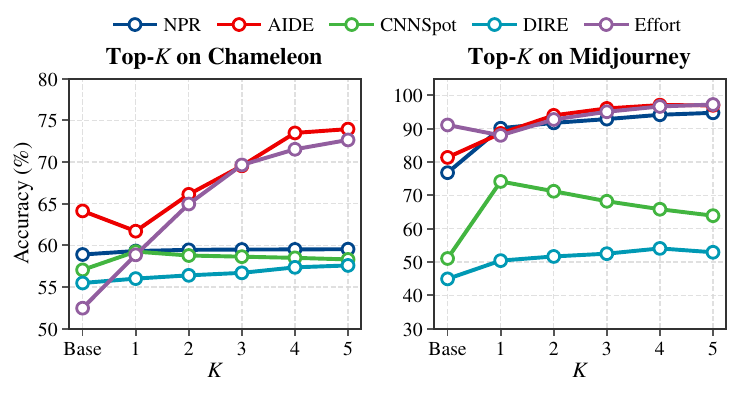
Follow RGB instances through Cross-Shuffle, then explore top-k aggregation with measured tile scores.
Loading RGB examples…
RGB crops represent feature-token instances. The training operation acts on embeddings; the mosaics below show their provenance.
8 of 16 instances per bag; at least 1 original remains.
The real target excludes its own image. The generated target can draw from all three real images.
16 original · 0 inserted
16 original · 0 inserted
Original bags. Click any crop to inspect its source.
Take non-overlapping 224 × 224 blocks first, then add right/bottom boundary blocks where needed. Only those boundary blocks may overlap. Each crop is scored independently. Select k to highlight the highest generated probabilities and compute their arithmetic mean.
Click a crop to inspect its original coordinates and score.
These are precomputed model scores. The released GenImage LTF Fusion checkpoint (CLIP block 24, CPU float32) scores each RGB crop as a standalone image. This illustrates FATAS, separately from standard whole-image hierarchical LTF inference.
Full blocks use a 224-pixel stride. Any remaining right/bottom strip is covered by one boundary-aligned block, which may overlap its neighbor. RGB files are unchanged GenImage validation examples. Download scores and crop coordinates · Sources and protocol
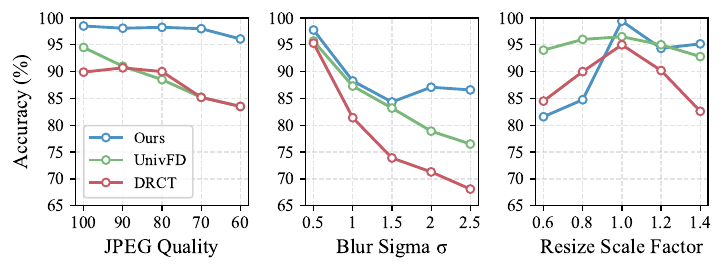
Compress, blur, or downsample an image. See how the pixels and the detector’s score change together.
Loading measured examples…
Click a point to select its image. The dashed line is the 0.5 decision threshold.
Each setting is a separate, measured whole-image LTF prediction with the released GenImage checkpoint and CLIP block 24. Local 224 × 224 blocks do not overlap; only final right/bottom boundary blocks may overlap. The global view is included. Standard LTF aggregation is used.
One transformation is applied to the original at a time. JPEG uses the displayed quality; blur uses the displayed Pillow Gaussian radius; resize uses LANCZOS and passes the smaller image directly to the model. The original is the reference for every curve. These individual examples do not replace a benchmark robustness evaluation.
Eight L1 aggregation heads, one image. Explore how each head weights the same local tiles.
Loading measured attention…
Hover, focus, or click a tile in any map. The selected crop stays linked across all eight heads; use the tile selector to reach overlapping crops.
These are the eight learned L1 aggregation heads across local tiles. Each head’s weights sum to one. A weight of 1/N is uniform attention over N local tiles. The separate global view belongs to L2 and is excluded from these maps.
All maps share a fixed log₂ color scale from 0.25× to 4× uniform attention. Overlapping regions show the mean weight of covering tiles. Similar weights have similar colors. Attention shows relative model weighting, not a pixel-level forgery probability or a causal explanation.
Upload an original image to inspect its prediction, local tiles, L1/L2 attention, individual aggregation heads, and patch weights. Attention represents relative model weighting, not pixel-level forgery probabilities.
For local use, see the demo source and instructions.
 TODO
@inproceedings{chen2026ltf,
  title={Learning to Falsify: Hierarchical Multiple Instance Learning for High Resolution AI-Generated Image Detection},
  author={Chen, Haoran and Gao, Daiqi and Li, Xinyuan and Wang, Yongwei and Zhu, Lei and Cai, Rui and Dong, Jianfeng},
  booktitle={Proceedings of the 34th ACM International Conference on Multimedia},
  year={2026},
  doi={10.1145/3767308.3836365},
  eprint={2611.04529},
  archivePrefix={arXiv}
}